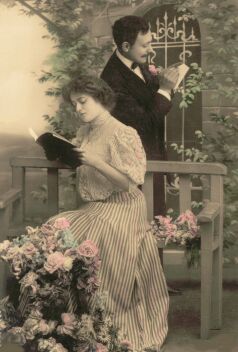
Chapter Six –
Conversation
The finest
compliment that can be paid to a woman of refinement and esprit is to
lead the conversation into such a channel as may mark your appreciation of her
superior attainments.
Let your
conversation be adapted as skillfully as may be to your company. Some men make
a point of talking commonplaces to all ladies alike, as if a woman could only
be a trifler. Others, on the contrary, seem to forget in what respects the
education of a lady differs from that of a gentleman, and commit the opposite
error of conversing on topics with which ladies are seldom acquainted. A woman
of sense has as much right to be annoyed by the one as a lady of ordinary
education by the other.
Subjects to be Avoided.
In talking with ladies of ordinary education, avoid political, scientific or
commercial topics, and choose only such subjects as are likely to be of
interest to them.

Talk to People of Their Own Affairs.
Remember that people take more interest in their own affairs than in anything
else which you can name. if you wish your conversation to be thoroughly
agreeable, lead a mother to talk of her children, a young lady of her last
ball, an author his forthcoming book, or an artist of his exhibition picture.
Having furnished the topic, you need only listen; and you are sure to be
thought not only agreeable, but thoroughly sensible and well-informed.
Avoid Talking too much of their Professions.
Be careful, however, on the other hand, not always to make a point of talking
to persons upon general matters relating to their professions. To show an
interest in their immediate concerns is flattering; but to converse with them
too much about their own arts looks as if you thought them ignorant of other
topics.
Avoid Classical Quotations.
Do not use a classical quotation in the presence of ladies without apologizing
for, or translating it. Even this should only be done when no other phrase
would so aptly express your meaning. Whether in the presence of ladies or
gentlemen, much display of learning is pedantic and out of place.
Modulations.
There is a certain distinct but subdued tone of voice which is peculiar to only
well-bred persons. A loud voice is both disagreeable and vulgar. It is better
to err by the use of too low than too loud a tone.
Slang.
Remember that all “slang” is vulgar. It has become of late unfortunately
prevalent, and we have known even ladies pride themselves on the saucy chique
with which they adopt certain cant phrases of the day. Such habits cannot be
too severely reprehended. They lower the tone of society and the standard of
thought. It is a great mistake to suppose that slang is in any way a substitute
for wit.
Using Proverbs and Puns.
The use of proverbs is equally vulgar in conversation; and puns, unless they
rise to the rank of witticisms, are to be scrupulously avoided. There is no
greater nuisance in society than a dull and persevering punster.
Avoid Long Arguments.
Long arguments in general company, however entertaining to the disputants, are
tiresome to the last degree to all others. You should always endeavor to
prevent the conversation from dwelling too long upon one topic.
Interrupting a Person while Speaking.
Never interrupt a person who is speaking. It has been aptly said that “if you
interrupt a speaker in the middle of his sentence, you act almost as rudely as
if, when walking with a companion, you were to thrust yourself before him, and
stop his progress.”
Whispering in Society.
It is considered extremely ill-bred when two persons whisper in society, or
converse in a foreign language with which all present are not familiar. If you
have private matters to discuss, you should appoint a proper time and place to
do so, without paying other the ill compliment of excluding them from your
conversation.
If a foreigner
be one of the guests at a small party, and does not understand English
sufficiently to follow what is said, good-breeding demands that the
conversations shall be carried on (when possible) in his own language. If at a
dinner-party, the same rule applies to those at his end of the table.
Make the Topic of Conversation Known.
If upon the entrance of a visitor you carry on the thread of a previous
conversation, you should briefly recapitulate to him what has been said before
he arrived.
Witticisms.
Do not be always witty, even though you should be so happily gifted as to need
the caution. To outshine others on every occasion is the surest road to
unpopularity.
Always look, but
never stare, at those with whom you converse.
In order to meet
the general needs of conversation in society, it is necessary that a man should
be well acquainted with the current new and historical events of at least the
last few years.
Avoid Unfamiliar Subjects.
Never talk upon subjects of which you know nothing, unless it be for the
purpose of acquiring information. Many young men imagine that because they
frequent exhibitions and operas they are qualified judges of art. No mistake is
more egregious or universal.
Introducing Anecdotes.
Those who introduce anecdotes into their conversation are warned that these
should invariably be “short, witty, eloquent, new and not far-fetched.”
Scandal is the
least excusable of all conversational vulgarities.
In conversation
study to be quiet and composed. Do not talk too much, and do not inflict upon
your hearers interminably long stories, in which, at the best they can have but
a little interest.
Correct Pronunciation.
Take pains to pronounce your words correctly. Some people have a strangely
vulgar way of saying hos-pit-able for
hos-pit-able; inter-est-ing
for in-ter-esting.
Avoid Repeating.
Some persons have an awkward habit of repeating the most striking parts of a
story, especially the main point, if it has taken greatly the first time. This
is in very bad taste, and always excites disgust. In most cases, the story
pleased the first time, only because it was unexpected.
Cultivating the Mind.
Your conversation can never be worth listening to unless you cultivate your
mind. To talk well you must read much. A little knowledge on many subjects is
soon acquired by diligent reading. One does not wish to hear a lady talk
politics nor a smattering of science; but she should be able to understand and
listen with interest when politics are discussed, and to appreciate, in some
degree, the conversation of scientific men.
Music.
A well-bred lady of the present day is expected to know something of music
besides merely playing a difficult piece. She should be able to discuss the
merits of different styles of music, modestly and intelligently; a little
reading on the subject, and some attention
to the intellectual character of music, will enable her to do so; and as
music is becoming quite a national passion, she will find the subject brought
forward very frequently by gentlemen.
“A Low Voice.”
I think one can always tell a lady by her voice and laugh—neither of which
will ever be loud or course, but soft, low, and nicely modulated.
Shakespeare’s unfailing taste tells us that—
“A low voice is an excellent thing in a woman.”
And we believe that the habit of never raising the voice would tend much to the
comfort and happiness of many a home: as a proof of good breeding, it is
unfailing.
Talk Well about Trifles.
You should endeavor to have the habit of talking well about trifles. Be careful
never to make personal remarks to a stranger on any of the guests present: it
is possible, nay probable, that they may be relatives, or at least friends.
Double Entendres.
I need not say that no person of decency, still less delicacy, will be guilty
of a double entendre. Still, as there are persons in the world
possessing neither of these characteristics who will be guilty of them in the
presence of people more respectable than themselves, and as the young and
inexperienced are sometimes in doubt how to receive them, it is well to make
some reference to them in a book of this character. A well-bred person always
refuses to understand a phrase of doubtful meaning. If the phrase may be
interpreted decently, and with such interpretation would provoke a smile,
then smile to just called for by such interpretation, and no more. The
prudery which sits in solemn and severe rebuke at a double entendre is
only second in indelicacy to the indecency which grows hilarious over it, since
both must recognize the evil intent. It is sufficient to let it pass
unrecognized.
Indelicate Words and Expressions.
Not so when one hears an indelicate word or expression, which allows of no
possible harmless interpretation. Then not the shadow of a smile should flit
across the lips. Either complete silence should be preserved in return or the
words, “I do not understand you,” be spoken. A lady will always fail to
hear that which she should not hear, or, having unmistakably heard, she will
not understand.
A lady was once
in the streets of the city alone after dark, and a man accosted her. She
replied to him in French. He followed her some distance trying to open a
conversation with her; but as she persisted in replying only in French, he at
last turned away, completely baffled in his efforts to understand or be
understood.
Profanity.
A gentleman should never permit any phrase that approaches to an oath, to
escape his lips in the presence of a lady. If any man employs a profane
expression in the drawing-room, his pretensions to good-breeding are gone
forever. The same reason extends to the society of men advanced in life; and he
would be singularly defective in good taste, who should swear before old
persons, however irreligious their own habits may be. The cause of profanity
being offensive in these cases is that it denotes an entire absense of
reverence and respect from the spirit of him who uses it.
Listening.
“A dearth of
words,” says Young.
“A
woman need not fear,
But ’tis task,
indeed to learn to hear;
In that,
the skill of conversation lies;
That shows or
makes you both polite and wise.”
Listening is not only a point of good-breeding and the best kind of flattery,
but it is a method of acquiring information which no man of judgment will
neglect. “This is a common vice in conversation,” says Montaigue, “that
instead of gathering observations from others, we make it our whole business to
lay ourselves open to them, and are more concerned how to expose and set out
our own commodities, than how to increase our stock by acquiring new. Silence
therefore, and modesty, are very advantageous qualities in conversation.”
Give Credit for what You Learn.
But if a person gets knowledge in this way from another, he should ways give
him due credit for it: and not endeavor to sustain himself in society upon the
claims that really belong to another. “It is a special trick of low
cunning,” says Walpole, with a very natural indignation, “to squeeze out
knowledge from a modest man, who is eminent in any science; and then to use it
as legally acquired, and pass the source in total silence.”
The Best kind of Conversation.
That conversation is the best which furnishes the most entertainment to the
person conferred with, and calls upon him for the least exercise of mind. It is
for this reason that argument and difference are studiously avoided by
well-bred people; they tax and tire. It should be the aim of every one to utter
his remarks in such form that the expression of assent or opposition need not
follow from him he speaks with.
Interjections.
The interjection of such phrases as, “You know,” “You see,” “Don’t
you see?” “Do you understand?” and similar ones that stimulate the
attention, and demand an answer, ought to be avoided. Make your observations in
a calm and sedate way, which your companion may attend to or not, as he
pleases, and let them go for what they are worth.
Avoid Wounding the Feelings of Another.
To avoid wounding the feelings of another, is the key to almost every problem
of manners that can be proposed; and he who will always regulate his sayings
and doings by that principle, may chance to break some conventional rule, but
will rarely violate any of the essentials of good-breeding. Judgment and
attention are as necessary to fulfill this precept, as the disposition; for, by
inadvertence or follow as much pain may be given as by designed malevolence.
Affectations.
One of the first virtues of conversation is to be perspicuous and intelligible.
Those quaint and affected constructions, and high-flown, bookish phases, in
which some indulge, to the embarrassment of those they talk to, are in bad
taste and should be avoided. There have indeed at times appeared writers and
schools of rhetoric who cultivated obscurity as a merit.
Use Plain Words.
A man of good sense will always make a point of using the plainest and simplest
words that will convey his meaning; and will bear in mind that his principal or
only business is to lodge his idea in the mind of his hearer. The same remark
applies to distinctness of articulation; and Hannah More has justly observed
that to speak so that people can hear you is one of the minor virtues.
Avoid Wit which Wounds.
Those who have generosity enough to care for the feelings of others, or
self-regard enough to covet good-will, will be careful to avoid every display
of wit which wound another. It is a happy circumstance for the honor of our
nature, and one very characteristical of the kindness of Providence, that a
display of the easiest moral virtues will generally bring us more popularity
than the exhibition of the greatest talents without them.
Parts may be praised, good nature is ador’d;
Then draw your wit as seldom as your sword,
And never on the weak.
Those who scatter brilliant jibes without caring whom they wound, are as unwise
as they are unkind. Those sharp little sarcasms that bear a sting in their
words, rankle long, sometimes forever, in the mind, and fester often into fatal
hatred never to be abated.
Proper Reserve.
Everyone should avoid displaying his mind and principles and character
entirely, but should let his remarks only open glimpses to his understanding.
For women this precept is still more important. They are like moss-roses, and
are most beautiful in spirit and intellect, when they are but half-unfolded.
Professional Peculiarities.
When a man goes into company, he should leave behind him all peculiarities of
mind and manners. That, indeed, constituted Dr. Johnson’s notion of a
gentleman; and as far as negatives go, the notion was correct. It is in bad
taste, particularly, to employ technical or professional terms in general
conversation. Young physicians and lawyers often commit that error.
The most eminent
members of those occupations are the most free from it; for the reason, that
the most eminent have the most sense.
Modesty.
Young men often, through real modesty, put forth their remarks in the form of
personal opinions; as, with the introduction of, “I think so-and-so,” or,
“Now, I, for my part, have found it otherwise.” This is generally prompted
by humility; and yet it has an air of arrogance. The person who employ such
phrases, mean to shrink from affirming a fact into expressing a notion, but are
taken to be designing to extend an opinion into an affirmance of a fact.
Conversing with Ladies.
If you are a gentleman, never lower the intellectual standard of your
conversation in addressing ladies. Pay them the compliment of seeming to
consider them capable of an equal understanding with gentlemen. You will, no
doubt, be somewhat surprised to find in how many cases the supposition will be
grounded in fact, and in the few instances where it is not the ladies will be
pleased rather than offended at the delicate compliment you pay them. When you
“come down” to commonplace or small-talk with an intelligent lady, one of
two things is the consequence, she either recognizes the condescension and
despises you, or else she accepts it as the highest intellectual effort of
which you are capable, and rates you accordingly.
Conclusion.
The foregoing rules are not simply intended as good advice. They are strict
laws of etiquette, to violate any one of which justly subjects a person to the
imputation of being ill-bred. But they should not be studied as mere arbitrary
rules. The heart should be cultivated in the right manner until the acts of the
individual spontaneously flow in the right channels.
A recent writer
remarks on this subject: “Conversation is a reflex of character. The
pretentious, the illiterate, the impatient, the curious, will as inevitably
betray their idiosyncrasies as the modest, the even-tempered and the generous.
Strive as we may, we cannot always be acting. Let us therefore, cultivate a
tone of mind and a habit of life the betrayal of which need not put us to shame
in the company of the pure and wise; and the rest will be easy. If we make
ourselves worthy of refined and intelligent society, we shall not be rejected
from it; and in such society we shall acquire by example all that we have
failed to learn from precept.”
Chapter Seven – Visits and Visiting
Of visits there
are various kinds, visits of congratulations, visits of condolence, visits of
ceremony, visits of friendship.
Such visits are
necessary, in order to maintain good feeling between the members of society;
they are required by the custom of the age in which we live and must be
carefully attended to.
Visits of Congratulations.
Upon the appointment of one of your friends to any office or dignity, you call
upon him to congratulate, not him, but the country, community or state, on
account of the honor and advantage which it derives from the appointment.
If one of your
friends has delivered a public oration, call upon him when he has returned
home, and render to him your thanks for the great pleasure and satisfaction for
which you are indebted to him, and express your high estimation of the
luminous, elegant, &c. discourse, trusting that he will be prevailed upon
to suffer it published.
Visits of Ceremony or Calls.
Visits of ceremony, merging occasionally into those of friendship, but
uniformly required after dining at a friend's house. Professional men are
not however, in general, expected to pay such visits, because their time is
preoccupied; but they form almost the only exception.
Time to Make Ceremonious Visits.
Visits of ceremony must be necessarily short. They should on no account be made
before the hour, nor yet during the time of luncheon. Persons who intrude
themselves at unwonted hours are never welcome; the lady of the house does not
like to be disturbed when she is perhaps dining with her children; and the
servants justly complain of being interrupted at the hour when they assemble
for their noon-day meal. Ascertain, therefore, which you can readily do, what
is the family hour for luncheon, and act accordingly.
Keep and account of Ceremonial Visits.
Keep a strict account of your ceremonial visits. This is needful, because time
passes rapidly; and take note how soon your calls
are returned. You will thus be able, in most cases, to form an opinion
whether or not your frequent visits are desired. Instances may however occur,
when, in consequence of age of ill health, it is desirable that you should
call, without any reference to your visits being returned. When desirous to act
thus, remember that if possible, nothing should interrupt the discharge of this
duty.
Visits of Ceremony among Friends.
Among relations and intimate friends, visits of mere ceremony are unnecessary.
It is however, needful to call at
suitable times, and to avoid staying too long if your friend is engaged. The
courtesies of society, as already noticed, must ever be maintained even in the
domestic circle, or among the nearest friends.
Calling at an Inconvenient Hour.
Should you call by chance at an inconvenient hour, when perhaps the lady is
going out, or sitting down to luncheon, retire as soon as possible, even if
politely asked to remain. You need not let it appear that you feel yourself an
intruder; every well-bred or even good-tempered person knows what to say on
such an occasion; but politely withdraw with a promise to call again, if the
lady seems to be really disappointed.
Visiting at Hotels.
If you call to see a friend who is staying at lodgings, however intimate you
may be wit h him, wait below until a servant has carried up your name and
returned to tell you whether you can be admitted. If you cannot find any one to
announce you, you should knock gently at the chamber-door, and wait a little
while before entering. If you are in to great a hurry, you might the person
drawing off a night-cap. These decent formalities are necessary even in the
most unreserved friendships; they preserve the “familiar” from degenerating
into the “vulgar.” Disgust will very speedily arise between persons who
bolt into one another’s chambers, throw open the windows and seat themselves
without being desired to do so. Such intimacies are like the junction of two
electrical balls, -- only the prelude of a violent separation.
Visiting the Sick.
In calling to see a person confined by illness to his room, it is not enough
that you send up your name; you must wait till the servant returns.
Style of Conversation.
The style of your conversation should always be in keeping with the character
of your visit. You must not talk about literature in a visit of condolence not
lecture on political economy in a visit of ceremony.
Visits of Condolence.
Visits of condolence should be paid within a week after the event which
occasions them; but if the acquaintance be slight, immediately after the family
appear at public worship. A card should be sent up; and if your friends are
able to receive you, let your manners and conversation be in harmony with the
character of your visit. It is courteous to send up a mourning card; and for
ladies to make their calls in black silk or plain-colored apparel. It denotes
that they sympathize with the afflictions of the family; and such attentions
are always pleasing.
Before Going Abroad.
When you are going abroad, intending to be absent for some time, you enclose
your card in an envelope, having, first, written p.p.c.
upon it;--they are the initials of the French phrase, “pour prendre conge”—to take leave, and may wit equal propriety
stand for presents parting compliments.
Taking Leave of a Family.
In taking leave of a family, you send as many cards as you would if you
were paying an ordinary visit. When you return from your voyage, all the
persons to whom, before going, you have sent cards, will pay you the first
visit.
Meeting Other Visitors.
If a gentleman call at a house when a woman is visiting there at the same time,
and there is no male relation of the mistress of the house present, he should
rise, when she takes leave, and accompany her to her carriage, opening the
doors for her. If his visit has been of tolerable length, it were less awkward,
if he were to take leave at the same time; if not, return to the parlor.
Gentlemen’s Morning Call.
Gentlemen will do well to bear in mind that, when they pay morning calls, they
must carry their hats with them into the drawing-room; but on no account put
them on the chairs of table. There is a graceful manner of holding a hat, which
every well-bred man understands.
Returning From the Country.
In the beginning of the season, after persons have returned from the country,
and at the close of it when you are about to leave town, you should call upon
all your acquaintance. T is polite and pleasant to do the same on News’ day,
to wish your friends the compliments of that season.
Cards for Ceremonious Visits.
It is becoming more usual for visits of ceremony to be performed by cards; it
will be a happy day when that is universal.
Calling on Strangers.
If a stranger belonging to your own class of society comes to town, you should
call upon him. That civility should paid even if there be no previous
acquaintance; and it does not require the ceremony of an introduction. In going
to another city, you should in general wait to be visited; but the etiquette
id different in many cities of our country.
Engaged or not at Home.
When you call to see a person, and are informed at the door, that the party
whom you ask for, is engaged, you should never persist in your attempt to be
admitted, but should acquiesce at once in their arrangements which the others
have made for their convenience, to protect themselves from interruption.
However intimate you may be in any house, you have no right nor reason, when an
order has been given to exclude general visitors, and no exception has been
made of you, to violate that exclusion and declare that the party shall be at
home to you. I have known several persons who have had the habit of forcing an
entrance into a house, after having been thus forbidden; but whatever has been
the degree of intimacy, I never knew it done without giving an offence
bordering on disgust. There are many times and seasons at which a person
chooses to be entirely alone, and when there is no friendship for which when
would give up his occupation or his solitude.
Evening Visits.
Evening visits are paid only to those with whom we are well acquainted. They
should not be very frequent even where one is intimate, nor should they be much
protracted. Frequent visits will gain for a man, in any house, the reputation
of tiresome, and long visits will invariable bring down the appellation of bore.
Morning visits are always extremely brief, being matters of mere ceremony.
Friendly Calls.
It is not necessary to mention friendly calls, except to state, that almost all
ceremony should dispense with. They are made at all house without much
preparation or dressing; a too brilliant attire would be out of place, and if
the engagement of the day carry you in such a costume to the house of a friend,
you ought obligingly to make an explanation.
Keep Account of Visits.
With a friend of relation whom we treat as such, we do not keep an account of
our visits. The one who has the most leisure calls on the one who has the
least; but this privilege ought not to be abused; it is necessary to make our
visits of friendship are suitable times. On the contrary, a visit of ceremony
should never be made without keeping an account of it, and we should even
remember the intervals at which they are returned, for it is indispensably
necessary to let a similar interval elapse. People in this way give you notice
whether they wish to see you often or seldom. There are some persons whom one
goes to see once in a fortnight; others, once a month; and others, less
frequently.
Omitting Visits.
In order not to omit visits, which are to be made, or to avoid making them form
misinformation, when a preceding one has not been returned, persons who have an
extensive acquaintance will do well to keep a little memorandum-book for this
purpose.
Ceremonious Visits.
We cannot make ceremonious visits in a becoming manner, if we have any sight
indisposition which may for the time affect our appearance or voice, which
embarrass our thoughts, and render our company fatiguing.
Suitable Times for Visits.
To take a suitable time for one’s self, of for others, is indispensable in
visiting, as in everything else; if you can obtain this by remembering the
habits of the person you are oing to see, by making arrangements so as not to
call at the time of taking meals, in moments of occupation, and when they are
likely to be walking. This time necessarily varies; but as a general rule we
must take care not to make ceremonious visits, either before the middle of the
day or after four o’clock. To do otherwise would, on the one hand, look like
importunity, be presenting one’s self too early, and on the other might
interfere with arrangements that had been made for the evening.
How to treat Visitors.
A well-bred person always receives visitors at whatever time they may call, or
whoever they may be; but if you are occupied and cannot afford to be
interrupted by a mere ceremony, you should instruct the servant beforehand
to say that you are “Engaged.” The form “not at home” sometimes
employed by ladies cannot be too strongly condemned. However much one may try
to justify it, the fact remains that it is a falsehood. Any lady lowers
herself in her own and others estimation by resorting to prevarication, however
slight. If the servant once admits a visitor within the hall, you should
receive him at any inconvenience to yourself. A lady should never keep a
visitor waiting more than a minute, or two at most, and if she cannot avoid
doing so, must apologize on entering the drawing-room.
Taking a Seat while Visiting.
In good society, a visitor, unless he is a complete stranger, does not wait to
be invited to sit down, but takes a seat at once easily. A gentleman should
never take the principal place in the room, nor, on the other hand, sit at an
inconvenient distance from the lady of the house. He must hold his hat
gracefully, not put it on a chair or table, or, if he wants to use both hands,
must place it on the floor close to his chair.
Pay Equal Attention to All.
A well-bred lady, who is receiving two or three visitors at a time, pays equal
attention to all, and attempts, as much as possible, to generalize the
conversation, turning to all in succession. The last arrival, however, receives
a little more attention at first than the others, and the latter, to spare her
embarrassment, should leave as soon as convenient. People who out-sit two or
three parties of visitors, unless they have some particular motive for doing
so, come under the denomination as “bores.” A “bore” is a person who
does not know when you have had enough of his or her company.
Taking a Friend with you Visiting.
Be cautious how you take an intimate friend uninvited even to the house
of those with whom you may be equally intimate, as there is always a feeling of
jealousy that another should share your thoughts and feelings to the same
extent as themselves, although good breeding will induce them to behave civilly
to your friend on your account.
Privileges of Ladies.
Ladies in the present day are allowed considerable license in paying and
receiving visits; subject, however, to certain rules, which it is needful to
define.
Visiting Acquaintances Alone.
Young married ladies may visit their acquaintances alone; but they may not
appear in any public places unattended by their husbands or elder ladies. This
rule must
never be infringed, whether as regards exhibitions, or public libraries, museums,
or promenades; but a young married lady is at liberty to walk with her friends
of the same age, whether married or single. Gentlemen are permitted to call on
married ladies at their own houses. Such calls the
usa
ges of society permit, but
never without the knowledge and full permission of husbands.
A Lady Calling on a
Gent
leman.
A lady
nev
er calls on a gentleman, unless professionally or officially. It is not only
ill-bred, but positively improper to do so. At the same time, there is a
certain privilege in age, which makes it possible for an old bachelor like
myself to receive a visit from any married lady whom I know very intimately,
but such a call would certainly not be one of ceremony, and always presupposes
a desire to consult me on some point or other. I should be guilty of shameful
treachery, however, if I told any one that I had received such a visit, while I
should certainly expect that my fair caller would let her husband know of it.
Preference of Seats.
When morning visitors are announced, rise and advance toward them. If a lady
enters request her to be seated on a sofa; but if advanced in life, or the
visitor be an elderly gentleman, insist on their accepting an easy chair, and
place yourself, by them. If several ladies arrive at the same time, pay due
respect to age and rank, and seat them in the most honorable places; these, in
winter, are beside the fire.
Respect toward the Feeble and Aged.
Supposing that a young lady occupies such a seat, and a lady older than
herself, or superior in condition, enters the room, she must rise immediately,
and having courteously offered her place to the new comer, take another in a
different part of the room.
Discontinuing Work.
If a lady is engaged with her needle when a visitor arrives, she ought to
discontinue her work, unless requested to do otherwise; and not even then must
it be resumed, unless on very intimate terms with her acquaintance. When this,
however, is the case, the hostess may herself request permission to do so. To
continue working during a visit of ceremony would be extremely discourteous;
and we cannot avoid hinting to our lady readers, that even when a particular
friend is present for only a short time, it is somewhat inconsistent with
etiquette to keep their eyes fixed on a crochet or knitting-book, apparently
engaged in counting stitches, or unfolding the intricacies of a pattern. We
have seen this done, and are, therefore, careful to warn them on the subject.
There are many kinds of light and elegant, and even useful work, which do not
require close attention, and may be profitably pursued, and such we recommend
to be always on the work-table at those hours which, according to established
practice, are given to social intercourse.
Visiting Cards.
Visitors should furnish themselves with cards. Gentleman ought simply to put
their cards into their pocket, but ladies may carry them in a small elegant
portfolio, called a card-case. This they can hold in their hand and it will
contribute
essen
tially (with an elegant handkerchief of embroidered cambric,) to give them an
air of good taste.
Address on Cards.
On visiting cards, the address is usually placed under the name, towards the
bottom of the card, and in smaller letters. Mourning cards are surmounted with
a broad black margin; half mourning ones, with a black edge only.
Keeping Cards.
It is bad taste to keep the cards you have received around the frame of a
looking-glass; such an exposure shows that you wish to make a display of the names of visitors. When from some cause or other
which multiples visitors at your house; (such as a funeral or a marriage,) you
are obliged to return these numerous call, it is not amiss to preserve the
cards in a convenient place, and save yourself the trouble of writing a list;
but if, during the year, your glass is always seen bristling with smoke-dried
cards, it will be attributed, without doubt, to an ill-regulated self esteem.
If the call is made in a carriage, the servant will ask if the lady you wish to see is at home. If persons call on foot, they go themselves to ask the
servants.
Laying Aside the Bonnet.
The short time devoted to a ceremonious visit, the necessity of consulting a
glass in replacing the head-dress, and of being assisted in putting on the
shawl, prevent ladies from accepting the invitation to lay them aside. If they
are slightly familiar with the person they are visiting and
wis
h to be more at ease, they should ask permission, which should be granted them,
at the same time rising, to assist them in taking off their hat and shawl. An
arm-chair, or a piece of furniture at a distant part of the room, should
receive these articles; they should not be placed upon the couch, without the
mistress of the house puts them there.
Habitual
Visits.
At the house of a person whom we visit habitually, we can lay them aside
without a word, and a lady an even adjust her hair, &c. before the glass,
provided she occupies only a few moments in doing it. If a person you call upon
is preparing to go out, or to sit down at table, you should although asked to
remain, to retire as soon as possible. The person visited so unseasonably,
should on her part, be careful to conceal her knowledge, that the other wishes the visit ended quickly.
We should always
appear delighted to receive visitors; and should they make a short visit, you must
express your regret.
Short
Visits.
Ceremonious visits should be short; if the conversation ceases without being
again continued by the person you have come to see, and if she gets up from her
seat under any pretext whatever, custom requires you to make your salutation
and withdraw. If before this tacit invitation to retire, other visitors are
announced, you should adroitly leave them without saying much. If, while you
are present, a letter is brought to the person you are visiting, and she should
lay it down without opening it, you must entreat her to read it; she will
probably not do so, and this circumstance will warn you to shorten your visit.
Unintentional Intrusions.
In most families in this country, evening calls are the most usual. Should you
chance to visit a family, and find that they have a party, present yourself,
and converse for a few minutes with an unembarrassed air; after which you may
retire, unless urged to remain. A slight invitation, given for the sake of
courtesy, ought not to be accepted. Make no apology for your unintentional
intrusion; but let it be known, in the course of a few days, that you were not
aware that your friends had company.
True
Hospitality.
In receiving guests, your first object should be to make them feel at home.
Begging them to make themselves feel at home is not sufficient. You should
display a genuine unaffected friendliness. Whether you are mistress of a
mansion or a cottage, and invite a friend to share your hospitality, you must
endeavor, by every possible means, to render the visit agreeable. This should
be done without apparent effort, that the visitor may feel herself to be a
partaker in your home enjoyments, instead of finding that you put yourself out
of the way to procure extraneous pleasures. It is right that you seek to make
the time pass lightly; but if, on the other hand, you let a visitor perceive
that the whole tenor of your daily concerns is altered on her account a degree
of depression will be felt, and the pleasant anticipations which she most
probably entertained will fail to be recognized. Let your friend be assured,
from your manner, that her presence is a real enjoyment to you, an incentive to
recreations which otherwise would not be thought of in the common routine of
life. Observe your own feelings when you happen to be the guest of a person
who, though he may be very much your friend, and really glad to see you, seems
not to know what to do either with you or himself; and again, when in the house
of another you feel as much at ease as in your own. Mark the difference, more
easily felt than described, between the manners of the two, and deduce there
from a lesson for your own improvement.
Treatment of Guests.
If you have guests in your house, you are to appear to feel that they are all
equal for the time, for they all have an equal claim upon your courtesies.
Those of the humblest condition will receive full
as much attention as the rest, in order that you shall not painfully make
them feel their inferiority.
Offer your
guests the best that you have in the way of food and rooms, and express no
regrets and make no excuses that you have nothing better to give them.
Try to make your
guests feel at home; and do this, not by
urging them in empty words to do so but by making their stay as pleasant as
possible, at the same time being careful to put out of sight any trifling
trouble of inconvenience they may cause you.
Devote as much
time as is consistent with other engagements to the amusement and entertainment
of your guests.
Duties of the
Visitor.
On the other hand, the visitor should try to conform as much as possible to the
habits of the house which temporarily shelters him. He should
nev
er object to the hours at which meals are served, nor should he ever allow the
family to be kept waiting on his account.
It is a good
rule for a visitor to retire to his own apartment in the morning, or at least
seek out some occupation of his own, without seeming to need the assistance or
attention of host or hostess; for it is undeniable that these have certain
duties which must be attended to at this portion of the day, in order to leave
the balance of the time free for the entertainment of their guests.
If any family
matters of a private or unpleasant nature come to the knowledge of the guest
during his stay, he must seem both blind and dead, and
nev
er refer to them unless the parties interested speak of them first. Still more
is he under moral obligations
nev
er to repeat to other what he may have been forced to see and hear.
The rule on
which a host and hostess should act is to make their guests as much as
possible; that on which a visitor with the ordinary routine of the house.
It is not
required that a hostess should spend her whole time in the entertainment of her
guests. The latter may prefer to be left to their own devices for a portion of
the day. On the other hand it shows the worst of breeding for a visitor to
seclude himself from the family and seek his own amusements and occupations
regardless of their desire to join in them or entertain him. Such a guest had
better go to a hotel, where he can live as
ind
ependently as he chooses.
Give as little
trouble as possible when a guest, but at the same time
nev
er think of apologizing for any little additional trouble which your visit may
occasion. It would imply that you thought your friends incapable of
entertaining you without some inconvenience to themselves.
Keep your room
as neat as possible, and leave no articles of dress or toilet around to give
trouble to servants.
A
lady will not hesitate to make her own bed if few or no servants are kept; and
in the latter case she will do whatever else she can to lighten the labors of
her hostess as a return for the additional exertion her visit occasions.
Leavetaking.
Upon taking leave express the pleasure you have experienced in your visit. Upon
returning home it is an act of courtesy to write and inform your friends of
your safe arrival, at the same time repeating your thanks.
A host and
hostess should do all they can to make the visit of a friend agreeable; they
should
ur
ge him to stay as long as is consistent with his own plans, and at the same
time convenient to themselves. But when the time for departure has been finally
fixed upon, no obstacles should placed in the way of leavetaking. Help him in
every possible way to depart, at the same time giving him a general invitation
to renew the visit at some future period.
“Welcome the coming, speed the parting,
guest,”
expresses the
true spirit of hospitality.
Chapter Eight – Dinner-Parties and Balls.
Dinner has been pronounced by Dr. Johnson, to be, in civilized life, the most
important hour of the twenty-four. The etiquette of the dinner-table has a
prominence commensurate with the dignity of the ceremony. Like the historian of
Peter Bell, we commence at the commencement, and thence proceed to the moment
when you take leave officially, or vanish unseen.
Invitations.
In order to dine, the first requisite is—to be invited. The length of time
which the invitation precedes the dinner is always proportioned to the grandeur
of the occasion, and varies from two days to two weeks.
Reply to Invitation.
You reply to a note of invitation immediately, and in the most direct and
unequivocal terms. If you accept, you arrive at the house rigorously at the
hour specified. It is equally inconvenient to be too late and to be too early.
If you fall into the latter error, you find every thing in disorder; the master
of the house is in his dressing-room, changing his waistcoat; the lady is still
in the pantry; the fire not yet lighted in the parlor. If by accident or
thoughtlessness you arrive too soon, you may pretend that you called to inquire
the exact hour at which they dine, having mislaid the note, and then retire to
walk for an appetite.
Arriving too Late.
If you are too late, the evil is still greater, and indeed almost without remedy.
Your delay spoils the dinner and destroys the
appetite and temper of the guests; and you yourself are so much embarrassed at the inconvenience
you have occasioned, that you commit a thousand errors at table. If you do not
reach the house until dinner is served, you had better retire to a restaurant,
and thence send an apology, and not interrupt the harmony of the courses by
awkward excuses and cold acceptances.
Manners at Table.
Nothing
indicates the good breeding of a
gentleman so much as his manners at table. There are a thousand little points to
be observed, which, although not absolutely necessary, distinctly stamp the
refined and well-bred man. A man may pass muster by dressing well, and
may sustain himself tolerably in conversation; but if he be not perfectly “au fait” dinner will
betray him.
Dress Neatly for Dinner Party.
Always go to dinner as neatly dressed as possible. The expensiveness of you
apparel is not of much importance, but its freshness and cleanliness are
indispensable. The hands and finger-nails require especial attention. It is a
great insult to every lady at the table for a man to sit down to dinner with
his hands in a bad condition.
How Long to Remain after Dinner.
Politeness demands that you remain at least an hour in the parlor, after
dinner; and, if you can dispose of an entire evening, it would be well to devote
it to the person who has entertained you. It is excessively rude to leave the
house as soon as dinner is over.
Congenial Company.
The utmost care should be taken that all the company will be congenial to one
another, and with a similarity of taste and acquirements, so that there shall
be a common ground upon which they may meet.
Number of Guests.
The number of guests should not be too large. From six to ten form the best
number, being neither too large nor too small. By no means let the number at
table count thirteen, for certain people have a superstition about this number;
and though it is a very foolish and absurd one, it is courteous to respect it.
Manner of Writing Invitations.
The invitations should be written on small note-paper, which may have the
initial letter or monogram stamped upon it, but good taste forbids anything
more. The envelope should matched the sheet of paper.
The invitation
should be issued in the name of the host and hostess.
The form of
invitation should as follows:
“Mr. and Mrs.
Ford request the pleasure [or favor] of Mr. and Mrs. Harper’s company at
dinner on Thursday, the 13th of December, at 5 o’clock.”
An answer should
be returned at once, so that if the invitation is declined the hostess may
modify her arrangements accordingly.
Invitation Accepted.
An acceptance may be given in the following form:
“Mr. and Mrs.
Harper have much pleasure in accepting Mr. and Mrs. Ford’s invitation for
December 13th.”
Invitation Declined.
The invitation is declined in the following manner:
“Mr. and Mrs.
Harper regret that a previous engagement (or whatever the cause may be) will
prevent them from having the pleasure of accepting Mr. and Mrs. Ford’s
invitation for December 13th.”
Or,
“Mr. and Mrs.
Harper regret extremely that owing to [whatever the preventing cause may be,]
they cannot have the pleasure of dining with Mr. and Mrs. Ford on Thursday,
December 13th.”
Whatever the
cause for declining may be, it should be stated briefly yet plainly, that there
may be no occasion for misunderstanding or hard feelings.
Invitation to Tea-party.
The invitation to a tea-party may be less formal. It may take the form of a
friendly note, something in this manner:
“
Dear
Miss
Patterson,”
“We have some
friends coming to drink tea with us to-morrow: will you give us the pleasure of
your company also? We hope you will not disappoint us.”
One should
always say “drink tea,” not “take tea,” which is a vulgarism.
Reception of Guests.
When guests are announced, the lady of the house advances a few steps to meet
them; gives them her hand and welcomes them cordially.
Introduction of Guests.
If there are strangers in the company, it is best to introduce them to all
present, that they may feel no embarrassment.
Proceeding to Dinner.
When they are all assembled, a domestic announces that the dinner is served up;
at this signal we rise immediately, and wait until the amster of the house
requests us to pass into the dining-room, whither he conducts us be going
before. It is quite common for the lady of the house to act as guide to the
guests, while the master offers his arm to the lady of most distinction. The
guests also give their arms to the ladies, whom they conduct as far as the
table, and to the places which they are to occupy. Having arrived at the table,
each guest respectfully bows to the lady whom he conducts, and who in her turn
bows also.
Arranging Guests at Table.
It is one of the first and most difficult things, properly to arrange the
guests, and to place them in such a manner, that the conversation may always be
general during the entertainment; we should, as much as possible, avoid putting
next to one another, two persons of
the same profession, as it would necessarily result in an aside dialogue, which
would injure the general conversation, and consequently the gaiety of the
occasion. The two most distinguished gentlemen ought to be placed next the
mistress of the house; and the two most distinguished ladies next to the master
of the house; and right hand especially the place of honor.
Intermingling Guests.
If the number of gentleman is nearly equal to that of the ladies, we should
take care to intermingle them; we should separate husbands from their wives,
and remove near relations as far from one another as possible; because being
always together, they ought not to converse among themselves in a general
party.
At table, as
well as at all other places, the lady always takes precedence of the gentleman.
Asking the Waiter for Anything.
If you ask the waiter for anything, you will be careful to speak to him gently
in the tone of request, and not of command. To speak to a waiter
in a driving manner will create, among well-bred people, the suspicion that you
were sometime a servant yourself, and are putting on airs at the thought
of your promotion. Lord Chesterfield says: “If I tell a footman to bring me a
glass of wine, in a rough, insulting manner, I should expect that, in obeying
me, he would contrive to spill some of it upon me, and I am sure I should
deserve it.:
Praising Every Dish.
It is not good taste to praise extravagantly every dish that is set before you;
but if there are some things that are really very nice, it is well to speak in
their praise. But, above all things, avoid seeming
indifferent to the dinner that is provided for you, as that might be construed
into a dissatisfaction with it.
Picking Your Teeth at the Table.
Avoid picking your teeth, if possible, at the table, for however agreeable such
a practice might be to yourself, it may be offensive to others. The habit which
some have of holding one hand over the mouth, does not avoid the vulgarity of
teeth-picking at table.
Selecting a Particular Dish.
Unless you are requested to do so, never select any particular dish; but if your host asks you what part you prefer,
name some part, as in this case the incivility would consist in making your
host choose as well as carve for you.
Duties of Host and Hostess.
The lady and gentleman of the house, are of course helped last, and they are
very particular to notice, every minute, whether the waiters are attentive to
every guest. But they do not press people either to eat more than they appear
to want, not insist upon their partaking of any particular dish. It is
allowable for you to recommend, so far as to say that it is considered
“excellent,” but remember that tastes differ, and dishes which suit you,
may be unpleasant to others; and that, in consequence of your urgency some
modest people might feel themselves compelled to partake of what is
disagreeable to them.
Paring Fruit for a Lady.
Never pare an apple or a pear for a lady unless she desire you, and then be
careful to use your fork to hold it; you may sometimes offer to divide a
very large pear with or for a person.
Dipping
Bread Into Preserves.
It is considered vulgar to dip a piece of
bread into the preserves or gravy upon your plate and then bite it. If you desire
to eat them together, it is much better to break the bread into smaller pieces, and convey these to your mouth with your fork.
Soup.
Soup is the first course. All should accept it even if they let it remain
untouched, because it is better to make a pretence of eating until the next
course is served than to sit waiting or compel the servants to serve one before
the rest.
Soup should be
eaten with the side of the spoon, not from the point, and there should be noise
of sipping while eating it. It should not be called for a second time.
Fish.
Fish follows soup, and must be eaten with a fork, unless fish-knives are
provided. Put the sauce, when it is handed to you, on the side of your plate.
Fish may be
declined, but must not be called for a second time.
General Rules Regarding Dinner.
After soup and fish, come the side-dishes, which must be eaten with fork only,
though the knife may be used in cutting anything too hard for a fork.
Never apologize
to a waiter for requiring him to wait upon you; that is his business. Neither
reprove him negligence or improper conduct, that is the business of the host.
Never take up a
piece of asparagus or the bones of fowl of bird with your fingers to suck them,
possibly making the remark that “fingers were made before forks.” These
things should always be cut with a knife and eaten with a fork. If fingers were
made before forks, so were wooden trenchers before the modern dinner service.
Yet it would rather startle these advocates of priority to be invited to a
dinner-party where the dining-table was set with a wooden trencher in the
center, into which all the guests were expected to dip with their fingers.
Bread should be
broken, not bitten. This is, of course, taken with the fingers.
Be careful to
remove the bones from fish before eating it. If a bone get inadvertently into
the mouth, the lips must be covered with the napkin in removing it.
Cherry-stones
should be removed from the mouth as unobtrusively as possible and deposited on
the side of the plate. A good way is to watch how others are doing and follow
their example. A better way still is for the hostess to have her cherries
stoned before they are made into pies and puddings, and thus save her guests
this dilemma.
If it is an
informal dinner, and the guests pass the dishes to one another instead of
waiting to be helped by a servant, you should always help yourself from the
dish, if you desire to do so at all, before passing it on to the next.
A guest should
nev
er find fault with the dinner or with any part of it.
When you are
helped, begin to eat without waiting for other to be served.
A knife should
never, on any account, be put into the mouth. Many even well-bred people in other
particulars think this an unnecessary regulation; but when we consider that it
is a rule of etiquette, and that its violation causes surprise, and disgust to
many people, it is wisest to observe it;
As an
illustration of this point, I will quote from a letter from the late Wm. M.
Thackeray, addressed to a gentleman in
Philadelphia
: “The European continent swarms with your people. They are not all as
polished as Chester
field
. I wish some of them spoke French a little better. I saw five of them at supper at
Basle
the other night with their knives down their throats. It was awful! My daughter
saw it, and I was obliged to say, ‘My dear, your great-great grandmother, one
of the finest ladies of the old school I ever saw, always applied cold steel to
her wittles. It’s no crime to eat with a knife,’ which is all very well;
but I wish five of ’em at a time wouldn’t.”
Watching how Others do.
Speaking of watching how others are doing, and following their example, reminds
us of an anecdote told us not long since by the lady who played the principal
part in it.
She was visiting
at the house of a friend, and one day there was upon the dinner-table some
sweet corn cooked on the ear. Not knowing exactly how to manage it so as not to
give offense, she concluded to observe how the others did. Presently two of the
members of the family took up their ears of corn in their fingers and ate the
grain directly from the cob. So Miss Mary thought she might venture to eat hers
in the same manner. Scarcely had she begun, however, when her hostess turned to
her little boy and said, “I am going to let you eat your corn just like a
little pig to-day.”
“How is that,
momma?” questioned the boy.
“Look at Miss
Mary,” was the reply. “I am going to let you eat it just as Miss Mary is
eating hers.”
The mixed state
of Miss Mary’s feeling can be better imagined than described.
Never use a
napkin in the place of a handkerchief by wiping the forehead or blowing the
nose with it.
Do not scrape
your plate or tilt it to get the last drop of anything it may contain, or wipe
it out with a piece of
brea
d.
Pastry should be
eaten with a fork. Everything that can be cut without a knife, should be cut
with a fork alone.
Eat slowly.
Pudding may be
eaten with a fork or spoon. Ice requires a spoon.
Cheese must be
eaten with a fork.
Talk in a low
tone to your next neighbor, but not in so low a tone but that your remarks may
become general. Never speak with the mouth full.
Never lay your
hand or play with your fingers upon the table. Neither toy with your knife,
fork or spoon, make pills of your
brea
d nor draw imaginary lines upon the table-cloth.
Never bite
fruit. An apple, pear or peach should be peeled with a silver knife, and all
fruit should be broken or cut.
Urging Guests to Eat.
A mistress of a house ought never to appear to pride herself regarding what is on her table, nor confuse
herself with apologies for the bad cheer which she offers you; it is much
better for her to observe silence in this respect, and leave it to her guests to
pronounce eulogiums on the dinner; neither is it in good taste to urge guests
to eat nor to load their plate against their inclination.
Waiting on Others.
If a gentleman is seated by the side of a lady on elderly person, politeness
requires him to save them all the trouble of pouring out for themselves to
drink, or procuring anything to eat, and of obtaining whatever they are in want
of at the table and he should be eager to offer them what he thinks to be most
to their taste.
Monopolizing Conversation.
It would be impolite to monopolize a conversation which ought to be general. If
the company is too large we should converse with our neighbors, raising the
voice only loud enough to make ourselves heard.
Signal for Leaving the Table.
Is it for the mistress of the house to give the signal to leave the table; all
the guests then rise, and, offering their arms to the ladies, wait upon them to
the door.
You should not
leave the table before the end of the entertainment, unless from
ur
gent necessity.
We are glad to
say that the English habit of gentleman remaining at the table, after the
ladies have retired, to
ind
ulge in wine, coarse conversation and obscene jokes, has
nev
er been received into popular favor in this country. The very words
“after-dinner jokes” suggest something
ind
ecent. We take our manners from
Paris
instead of
London
, and ladies and gentlemen retire together from the dining-table instead of the
one sex remaining to pander to their baser appetites, and the other departing
with all their
del
icate sentiments in a state of outrage if their pause to think of the cause of
their dismissal.
After retiring
to the drawing-room the guests should intermingle in a social manner, and the
time until the hour of taking leave may be spent either in conversation or in
various entertaining games. It is expected the guests will remain two or three
hours after the dinner.
Dancing.
Lord Chesterfield, in his letters to his son, says: “Dancing is, in itself, a
very trifling and silly thing: but it is one of those established follies to
which people of sense are sometimes obliged to conform; and then they should be
able to do it well. And though I would not have you a dancer, yet, when you do
dance, I would have you dance well, as I would have you do everything you do
well.” In another letter, he writes: “Do you mind your dancing while your
dancing master is with you? As you will be often under the necessary of dancing
a minuet, I would have you dance it very well. Remember that the graceful
motion of the arms, the giving of your hand, and the putting off and putting on
of your hat genteelly, are the material parts of a gentleman’s dancing. But
the greatest advantage of dancing well is, that it necessarily teaches you to
present yourself, to sit, stand, and walk genteelly; all of which are of real
importance to a man of fashion.”
Giving a Ball.
If you cannot afford to give a ball in good style, you had better not attempt
it at all.
Having made up
your mind to give a ball and to do justice to the occasion, and having settled
upon the time, the next thing is to decide whom and how many to invite. In
deciding upon the number a due regard must be paid to the size of the rooms;
and after making allowance for a reasonable number who may not accept the
invitation, there should be no more invited than can find comfortable
accommodations, both sitting and standing-room being taken into account, and at
the same time have the floor properly free for dancing. The more guests you
have the more brilliant, and the fewer you have the most enjoyable, will the
occasion be.
Any number over
a hundred guests constitutes a ‘large ball:’ under fifty it is merely a
“dance.”
Choice of Guests.
As dancing is the amusement of the evening, due regard should be paid to
the dancing qualifications of the proposed guests.
Issuing Invitations.
The invitations issued and accepted for an evening party will be written in the
same style as those already described for a dinner-party. They should be sent
out at least from seven to ten days before the day fixed for the event,
and should be replied to within a week of their receipt, accepting or declining
with regrets. By attending to these courtesies, the guests will have time to
consider their engagements and prepare their dresses, and the hostess will also
know what will be the number of her party.
Prejudices against Dancing.
One should be scrupulous and not wound the prejudices of a friend by sending
her an invitation to a ball when it is well known she is conscientiously
opposed to dancing.
Notes of Interrogation.
No one now sends a note of interrogation to a dance; cards are
universally employed. The form of an invitation to a tea-party differs from
that to a dance, in respect that the one specifies that you are invited to
tea, the other does not, but merely requests the pleasure of your company on
such an evening, a perhaps names the hour.
Variety of Toilet.
Vary your toilet as much as possible, for fear that idlers and
mali
gnant wits, who are always a majority in the world, should amuse themselves by
making your dress the description of your person.
Choice of Attire.
Certain fashionables seek to gain a kind of reputation by the odd choice of
their attire, and by their eagerness to seize upon the first caprices of the
fashions. Propriety with difficulty tolerates these fancies of a spoiled child;
but it applauds a woman of sense and taste, who is not in a hurry to follow the
fashions, and asks how long they will last, before adopting them; finally, who
selects and modifies them with success according to her size and figure.
Evening Party.
If it is to be a simple evening party, in which we may wear a summer
walking-dress, the mistress of the house gives verbal invitations, and does not
omit to apprise her friends of this circumstance, or they might appear in
unsuitable dresses. If, on the contrary the soiree is to be in reality a ball,
the invitations are written, or what is better, printing and expressing in the
third person.
The Cloak Room.
A room appropriate for the purpose, and furnished with cloak-pins to hand up
the shawls and other dresses of the ladies, is almost
indispensable. Domestics should be there also, to aid them in taking off and
putting on their outside garments.
When to Arrive.
We are not obligated to go exactly at the appointed hour; it is even
fashionable to go an hour later. Married ladies are accompanied by their
husbands: unmarried ones, by their mother, or by an escort.
Refusing to Dance.
A lady cannot refuse the invitation of a gentleman to dance, unless she has
already accepted that of another, for she would be guilty of an incivility
which might occasion trouble; she would, moreover, seem to show contempt for
him whom she refused, and would expose herself to receive in secret an ill
compliment from the mistress of the house.
Giving a Reason for not Dancing.
When a young lady declines dancing with a gentleman, it is her duty to give him
a reason why, although some thoughtless ones do not. No matter how frivolous it
may be, it is simply an act of courtesy to offer him an excuse; while, on the
other hand, no gentleman ought so far to compromise his self-respect as to take
the slightest offense at seeing a lady by whom he has just been refused, dance
immediately after with some one else.
How to Ask a Lady to Dance.
In inviting a lady to dance with you, the words, “Will you honor me
with your hand for a quadrille?” or, “Shall I have the honor of
dancing this et with you?” are more used now than “Shall I have the pleasure?”
or, “Will you give me the pleasure of dancing with you?”
Leaving a Ball Room.
Married or young ladies, cannot leave a ball-room, or any other party, alone.
The former should be accompanied by one or two other married ladies, and the
latter by their mother, or by a lady to represent her.
Talking too Much.
Ladies should avoid talking too much; it will occasion remarks. It has also a
bad appearance to whisper continually in the ear of your partner.
Wall Flowers.
The master of the house should see that all the ladies dance; he should take
notice, particularly of those who seem to serve as drapery to the walls
of the ball-room, (or wall-flowers, as the familiar expression is,) and
should see that they are invited to dance. But he must do this wholly
unperceived, in order not to wound the self-esteem of the unfortunate ladies.
Duties of
Gentlemen.
Gentlemen whom the master of the house requests to dance with these ladies,
should be ready to accede to his wish, and even appear pleased at dancing with a person thus recommended to their
notice.
Duties of Ladies.
Ladies who dance much, should be very careful not to boast before those who
dance but little or not at all, of the great number of dances for which they
are engaged in advance. They should also, without being perceived, recommend to
these less fortunate ladies, gentlemen of their acquaintance.
While Dancing.
In giving the hand for ladies chain or any other figures, those dancing should
wear a smile, and accompany it with a polite inclination of the head, in the
manner of a salutation. At the end of the dance, the gentleman reconducts the
lady to her place, bows and thanks her for the honor which she has conferred.
She also bows in silence, smiling with a gracious air.
Reserve and
Politeness.
In these assemblies, we should conduct ourselves with reserve and politeness
towards all present, although they may be unknown to us.
When not to Dance.
Never hazard taking part in a quadrille, unless you know how to dance
tolerably; for if you are a novice, or but little skilled, you would bring
disorder into the midst of pleasure. Being once engaged to take part in a
dance, if the figures are not familiar, be careful not to advance first. You
can in this way govern your steps by those who go before you. Beware, also, of
taking your place in a set of dancers more skillful than yourself. When an
unpracticed dancer makes a mistake, we may apprize him of his error; but it
would be very impolite to have the air of giving him a lesson.
Grace and Modesty.
Dance with grace and modesty, neither affect to make a parade of your
knowledge; refrain from great leaps and ridiculous jumps, which would attract
the attention of all towards you.
Private Party.
In a private ball or party, it is proper for a lady to show still more reserve,
and not manifest more preference for one gentleman than another; she should
dance with all who ask properly.
Public Balls.
In public balls, a gentleman offers his partner refreshment, but which she
seldom accepts, unless she is well acquainted with him. But in private parties,
the persons who receive the company, send round cake and other refreshments, of
which everyone helps themselves. Near the end of the evening, in a well
regulated ball, it is customary to have a supper; but in a soiree, without
great preparation, we may dispense with a supper; refreshments are, however,
necessary, and not to have them would be the greatest impoliteness.
Visit of Thanks.
We should retire incognito, in order not to disturb the master and
mistress of the house; and we should make them, during the week, a visit of
thanks, at which we may converse of the pleasure of the ball and the good
selection of the company.
Deportment in Public Places.
The proprieties in deportment, which concerts require, are little different
from those which are recognized in every other assembly, or in public
exhibitions, for concerts partake of the one and the other, according as they
are public or private. In private concerts, the ladies occupy the front seats,
and the gentlemen are generally in groups behind, or at the side of them. We
should observe the most profound silence, and refrain from beating time,
humming the airs, applauding, or making ridiculous gestures of admiration. It
often happens that a dancing soiree succeeds a concert, and billets of
invitation, distributed two or three days before hand should give notice of it
to the persons invited.
General Rules for a Ball-room.
A lady will not cross a ball-room unattended.
A gentleman will
not take a vacant seat next to a lady who is a stranger to him. If she is an
acquaintance, he may do so with her permission.
White kid gloves
should be worn at a ball, and only be taken off at supper-time.
In dancing
quadrilles do not make any attempt to take steps. A quiet walk is all that is
required.
When a gentleman
escorts a lady home from a ball, she should not invite him to enter the house;
and even if she does so, he should by all means decline the invitation. He
should call upon her during the next day or evening.
As the guests
enter the room, it is not necessary for the lady of the house to advance each
time toward the door, but merely to rise from her seat to receive their
courtesies and congratulations. If,
ind
eed, the hostess
wis
hes to show particular favor to some particularly honored guests, she may
introduce them to others, whose acquaintances she may imagine will be
especially suitable and agreeable.
When entering a
private ball or party, the visitor should invariably bow to the company. No
well-bred person would omit this courtesy in entering a drawing-room; although
the entrance to a large assembly may be unnoticed.
Any presentation
to a lady in a public ball-room, for the mere purpose of dancing, does not
entitle you to claim her acquaintance afterwards; therefore, should you meet
her, at most her, at most you may lift your hat; but even that is better
avoided—unless, indeed, she first bow—as neither she nor her friends can
know who or what you are.
Never wait until
the signal is given to take a partner, for nothing is more impolite than to
invite a lady hastily, and when the dancers are already in their places; it can
be allowed only when the set is incomplete.
In private
parties, a lady is not to refuse the invitation of a gentleman to dance, unless
she be previously engaged. The hostess must be supposed to have asked her house
only those persons whom she knows to be perfectly respectable and of
unblemished character, as well as pretty equal in position; and thus, to
decline the offer of any gentleman present, would be a tacit reflection on the
gentleman or lady of the house.
Conclusion.
There is a custom which is sometimes practiced both in the assembly room and at
private parties, which cannot be too strongly reprehended; we allude to the
habit of ridicule and ungenerous criticism of those who are ungraceful or
otherwise obnoxious to censure, which is
indulged in by the thoughtless, particularly among the dancers. Of its gross
impropriety and vulgarity we need hardly express an opinion; but there is such
an utter disregard for the feelings of others implied in this kind of negative
censorship, that we cannot forbear to warn out young readers to avoid it. The
“Koran” says: “Do not mock—the mocked may be better than the mocker.”
Those you condemn may not have had the same advantages as yourself in acquiring
grace or dignity, while they may be infinitely superior in purity
of heart and mental accomplishments. The advice of
Chester
field
to his son, in his commerce with society, to do as you would be done by,
is founded on the Christian precept, and worthy of commendation. Imagine
yourself the victim of another’s ridicule, and you will cease to
indulge in a pastime which only gains for you the hatred of those you satirize, if
they chance to observe you, and the contempt of others who have noticed your
violation of politeness, and abuse of true society.
Chapter
Nine – Street
Etiquette.
Meeting a lady on the street, it is not customary in
England
for a gentleman to recognize or speak to her unless she first smiles or bows.
But on the continent of
Europe
the rule is reversed, and no lady, however intimate you may be with her, will
acknowledge you in the street unless you first honor her with a bow of
recognition. The
America
n fashion is not like either of them. For here the really well-bred man always
politely and respectfully bows to every lady he knows, and, if she is a
well-bred woman, she acknowledges the respect paid her. If she expects no
further acquaintance, her bow is a mere formal, but always respectful,
recognition of the good manners which have been shown her, and no gentleman
ever takes advantage of such politeness to push a further acquaintance uninvited. But why should a lady and gentleman, who know each
other, scornfully and doggedly pass each other in the streets as though they
were enemies? There is no good reason for such impoliteness, in the
practice of politeness. As compared with the English, the French or continental
fashion is certainly more consonant with the rules of good breeding. But the
America
n rule is better than either, for it is based upon the acknowledged general
principle, that it is every gentleman’s and lady’s duty to be polite in all
places. Unless parties have done something to forfeit the respect dictated by
the common rules of politeness, there should be no deviation from this
practice. It is a ridiculous idea that we are to practice ill-manners in the
name of etiquette.
Recognizing Friends on the Street.
While walking the street no one should be absent-minded as to neglect to
recognize his friends. If you do not stop, you should always bow, touch your
hat, or bid your friends good day. If you stop, you can offer your hand without
removing your glove. If you stop to talk, retire on one side of the walk. If your
friend has a stranger with him and you have anything to say, you should
apologize to the stranger. Never leave your friend abruptly to see another
person without asking him to excuse your departure. If you meet a gentleman of
your acquaintance walking with a lady whom you do not know, lift your hat as
you salute them. If you know the lady you should salute her first.
Never fail to
raise your hat politely to a lady acquaintance; nor to a male friend who may be
walking with a lady—it is a courtesy to the lady.
Omitting to Recognize Acquaintances.
A gentleman should never omit a punctilious observance of the rules of
politeness to his recognized acquaintances, from an apprehension that he will
not be met with reciprocal marks of respect. For instance, he should not refuse
to raise his hat to an acquaintance who is accompanied by a lady, lest her
escort should, from ignorance or stolidity, return his polite salutation with a
nod of the head. It is better not to see him, that to set the example of a rude
and
indecorous salutation. In all such cases, and in all cases, he who is most
courteous has the advantage, and should
never feel that he has made a humiliating sacrifice of his personal dignity. It is
for the party whose behavior has been boorish to have a consciousness of
inferiority.
Shaking Hands with a Lady.
Never offer to shake hands with a lady in the street if you have dark gloves,
as you may soil her white ones. If you meet a lady friend with whom you
wish converse, you must not stop, but turn and walk along with her; and should she
be walking with a gentleman, first assure yourself that you are not intruding
before you attempt to join the two in their walk.

Young Ladies Conduct on the Street.
After twilight, a young lady would not be conducting herself in a becoming
manner, by walking alone; and if she passes he evening with any one, she ought,
beforehand, to provide some one to come for her at a stated hour; but if this
is not practicable, she should politely ask of the person whom she is visiting,
to permit a servant to accompany her. But, however much this may be considered
proper, and consequently an obligation, a married lady, well educated, will
disregard it if circumstances prevent her being able, without trouble, to find
a conductor.
Accompanying Visitors.
If the host wishes to accompany you himself, you must excuse yourself politely for giving him
so much trouble but finish, however, by accepting. On arriving at your house,
you should offer him your thanks. In order to avoid these two inconveniences,
it will be well to request your husband, or some one of your relatives, to come
and wait upon you; you will, in this way, avoid all inconveniences, and be
entirely free from that harsh criticism which is sometimes indulged in,
especially in small towns, concerning even the most innocent acts.
Fulfilling an Engagement.
If, when on your way to fulfill an engagement, a friend stops you in the
street, you may, without committing any
breach of etiquette, tell him of your appointment, and release yourself from a long
talk, but do so in a courteous manner, expressing regret for the necessity.
Conduct while Shopping.
In inquiring for goods at a store, do not say, I want so and so, but say to the
clerk—show me such an article, if you please—or use some other polite form
of address. If you are obliged to examine a number of articles before you are
suited, apologize to him for the trouble you give him. If, after all, you
cannot suit yourself, renew your apologies when you go away, If you make only
small purchases, say to him—I am sorry for having troubled you for so
trifling a thing.
Taking off Your Glove.
You need not stop to pull off your glove to shake hands with a lady or
gentleman. If it is warm weather it is more agreeable to both parties that the
glove should be on—especially if it is a lady with whom you shake hands, as
the perspiration of your bare hand would be very like ly to soil her glove.
Asking Information.
If a lady addresses an inquiry to a gentleman on the street, he will lift his
hat, or at least touch it respectfully, as he replies. If he cannot give the
information required, he will express his regrets.
Crossing a Muddy Street.
When tripping over the pavement, a lady should gracefully raise her dress a
little above her ankle. With her right hand she should hold together the folds
of her gown and draw them toward the right side. To raise the dress on both
sides, and with both hands, is vulgar. This ungraceful practice can be tolerated
only for a moment when the mud is very deep.
Expensive Dresses in the Street.
Most
America
n ladies in our cities wear too rich and expensive dresses in the street. Some,
indeed, will sweep the side-walks with costly stuffs only fit for a drawing-room
or a carriage. This is in bad taste, and is what ill-natured people would term
snobbish.
Carriage of a Lady in Public.
A lady walks quietly through the streets, seeing and hearing nothing that she
ought not to see and hear, recognizing acquaintances with a courteous bow and
friends with words of greeting. She is always unobtrusive. She
nev
er talks loudly or laughs boisterously, or does anything to attract the
attention of the passers by. She simply goes about her business in her own
quiet, lady-like way, and by her preoccupation is secure from all the annoyance
to which a person of less perfect breeding might be subjected.
Forming Acquaintances in Public.
A lady, be she young or old, never forms an acquaintance upon the
streets or seeks to attract the attention or admiration of persons of the other
sex. To do so would render false
her claims to ladyhood, if it did not make her liable to far graver charges.
Demanding Attentions.
A lady
never demands attentions and favors from a gentleman, but always accepts them
gracefully and graciously and with expressed thanks.
Meeting a Lady Acquaintance.
A gentleman meeting a lady acquaintance on the street, should not presume to
join her in her walk without ascertaining that his company would be entirely
agreeable. It might be otherwise, and she should frankly say so. A married lady
usually leans upon the arm of her husband; but single ladies do not, in the
day, take the arm of the gentleman, unless they are willing to acknowledge an
engagement. Gentlemen always give place to ladies, and gentlemen accompanying
ladies, in crossing the street.
Stopping a Lady on the Street.
If you have anything to say to a lady whom you may happen to meet in the
street, however intimate you may be, do not stop her, but turn round and walk
in company; you take leave at the end of the street.
Crowding Before Another.
If stormy weather has made it necessary to lay a plank across the gutters,
which has become suddenly filled with water, it is not proper to crowd before
another, in order to pass over the frail bridge.
Giving the Arm.
In walking with a lady, it is customary to give her the right arm; but where
circumstances render it more convenient to give her the left, it may properly
be done. If you are walking with a lady on a crowded street, like State or
Madison
, by all means give her the outside, as that will prevent her from being
perpetually jostled and run against by the hurrying crowd.
When to Offer Your Arm.
You should offer your arm to a lady with who you are walking whenever her
safety, comfort, or convenience may seem to require such attention on your
part. At night your arm should always be tendered, and also when ascending the
steps of a public building. In walking with any person you should keep step
with military precision, and with ladies and elderly people you should always
accommodate your speed to theirs.
Returning a Salute.
If a lady with whom you are walking receives the salute
of a person who is a stranger to you, you should return it, not for yourself,
but for her.
Passing Before a Lady.
When a lady whom you accompany
wishes to enter a store, you should hold the door open and allow her to enter
first, if practicable; for you must
never pass before a lady anywhere, if you can avoid it, or without an apology.
Corner Loafers.
No gentleman will stand in the doors of hotels, nor on the corners of the
street, gazing impertinently at the ladies as they pass. That is such an
unmistakably sign of a loafer, that one can hardly imagine a well-bred doing
such a thing.
Shouting.
Never speak to your acquaintances from one side of the street to the other.
Shouting is a certain sign of vulgarity. First approach, and then make your
communication to your acquaintance or friend n a moderately loud tone of voice.
Gentleman
Walking with a Lady.
When two gentleman are walking with a lady in the street, they should not be
both upon the same side of her, but one of them should walk upon the outside and
the other upon her inside.
Crossing the Street with a Lady.
If you are walking with a woman who has your arm, and you cross the street, it
is better not to disengage your arm, and go round upon the outside. Such effort
evinces a palpable attention to form, and that is always to be avoided.
General Rules.
A lady should
nev
er take the arms of two men, one being upon either side; nor should a man carry
a woman upon each arm. The latter of these iniquities is practiced only in
Ireland
; the former perhaps in Kamtskatcha. There are, to be sure, some cases in which
it is necessary for the protection of the women; that they should both take his
arm, as in coming home from a concert, or in passing, on any occasion, through
the crowd.
Passing Through a Crowd.
In walking in the street with a woman, if at any place, by reason of the crowd,
or from other cause you are compelled to proceed singly, you should always
procede [sic] your companion.
In passing a
lady in the street, who is accompanied by a gentleman on the outside, there is
the same reason for your taking the inside that there would be for you to walk
on that side if you were with them. You should take that side, then, unless you
would pay the gentleman, if he were alone, the compliment of giving him the
wall.
Saluting a Lady.
When you salute a lady or a gentleman to whom you wish to show particular respect, in the street, you should take your hat entirely
off and cause it to describe a circle of at least ninety degrees from its
original resting place.
Ascending a Mountain.
If you are walking with a woman in the country,--ascending a mountain or
strolling by the back of a river, -- and your companion being fatigued, should
choose to sit upon the ground, on no account allow yourself to do the same, but
remain rigorously standing. To do otherwise would be flagrantly
indecorous and she would probably resent it as the greatest insult.
In mounting a
pair of stairs in company with a woman, run up before her; in coming down, walk
behind her.
Meeting on the Street.
If, in walking, you meet a friend, accompanied by one whom you do not know,
speak to both. Also, if you are walking with a friend who speaks to a friend
whom you are not acquainted with, you should speak to the person; and with as
much respect and ease as if you knew the party. If you meet a man whom you have
met frequently before, who knows your name, and whose name you know, it is
polite to salute him.
Intrusive Inquires on Meeting.
If you meet or join or are visited by a person who has a book or box, or any
article whatever, under his arm or in his hand, and he does not offer to show
to you, you should not, even if he be your most intimate friend, take it from
him and look at it. There may be many reasons why he would not like you to see
it, or be obliged to answer the inquiries or give the explanations connected to
it. That intrusive curiosity is very inconsistent with the delicacy of a well-bred man, and always offends in some degree.
Smoking while Walking.
In walking with a lady, never permit her to encumber herself with a book, parcel, or anything of that
kind, but always offer to carry it. As to smoking, it certainly is not
gentlemanly to smoke while walking with ladies; but modern notions on the
tobacco question are growing very lax, and when by the seaside or in the
country, or in any but fashionable quarters, if your fair companion does not
object to a cigar, but never a pipe, you will not compromise yourself very much by smoking one.
Taking off Your Hat.
If there is any man whom you wish to conciliate, you should make a point of taking off your hat to him as often
as you meet him. People are always gratified by respect, and they generally
conceive a good opinion of the understanding of one who appreciates their
excellence so much as to respect it. Such is the irresistible effect of an
habitual display of this kind of manner, that perseverance in it will often
conquer enmity and obliterate contempt.
Chapter Ten – Riding and Driving.
In these days of fast locomotion, etc., the very delightful recreation and exercise of riding on horseback is partaken of too
little. This is to be regretted for nothing is better calculated to develop the
physical health and animal spirits, nothing is more conducive to pleasure of a
rational character than the ride on horseback upon every pleasant day.
Etiquette of Riding.
The etiquette of riding is very exact and important. Remember that your left
when in the middle is called the near side, and your right the off
side, and that you always mount on the near side. In doing this put your
left food in the stirrup, your left hand on the saddle, then, as you take a
spring, throw your right leg over the animal’s back. Remember, also, that the
rule of the road, both in riding and driving, is, that you keep to the left,
or near side in meeting; and to the right, or off side in passing.
Riding in Public.
Never appear in public on horseback unless you have mastered the inelegance
attending a first appearance in the saddle. A novice make an exhibition of
himself, and brings ridicule on his friends. Having got a “seat” by a
little practice, bear in mind the advice conveyed in the old rhyme—
“Keep your head and your heart,”
Your hands and your heels keep down,
Press your knees close to your horse’s
sides,
And your elbows close to your own.”
This may be called the whole art of riding, in one lesson.
Riding with Ladies.
In riding with ladies, recollect that it is your duty to see them in their
saddles before you mount. And the assistance they require must not be rendered
by a groom; you must assist them yourself.
Assisting a Lady to Mount.
The lady will place herself on the near side of the horse, her skirt
gath
ered up in her left hand, her right hand on the pommel, keeping her face
towards the horse’s head. You stand at his shoulder, facing her, and stooping
hold your hand so that she may place her left foot in it; then lift it as she
springs, so as to aid her, but not to give such an impetus that, like
“vaulting ambition,” she looses her balance and “falls o’ the other
side.” Next, put her foot in the stirrup, and smooth the skirt of her habit.
Then you are at liberty to mount
yourself.
Pace in Riding.
The lady must always decide upon the pace. It is ungenerous to
ur
ge her or incite her horse to a faster gait that she feels competent to
undertake.
Keep to the
right of the lady or ladies riding with you.
Open all gates
and pay all tolls on the road.
Meeting Friends on Horseback.
If you meet friends on horseback do not turn back with them; if you overtake
them do not thrust your company on them unless you feel assured that it is
agreeable to them for you to do so.
Meeting a Lady.
If, when riding out, you meet a lady with whom you are acquainted, you may bow
and ride on; but you cannot with propriety carry on a conversation with her
while you retain your seat on horseback. If very anxious to talk to her, it
will be your duty to alight, and to lead your horse.
Assisting a Lady to Alight from a Horse.
After the ride the gentleman must assist his companion to alight. She must
first free her knee from the pommel and be certain that her habit is entirely
disengaged. He must then take her left hand in his right and offer his left
hand as a step for her foot. He must lower this hand gently and allow her to
reach the ground quietly without springing. A lady should not attempt to spring
from the saddle.
Entering a Carriage.
If you enter a carriage with a lady, let her first take her place on the seat
facing the horses; then sit opposite, and on no account beside her, unless you
are her husband or other near relative. Enter a carriage so that your back is
toward the seat you are to occupy; you will thus avoid turning round in the
carriage, which is awkward. Take care that you do not trample the ladies’
dresses, or shut them in as you close the door.
Alighting from a Carriage.
The rule in all cases is this: You quit the carriage first and hand the lady
out.
It is quite an
art to descend from a carriage properly. More attention is paid to this matter
in
England
than in
America
. We are told an anecdote by M. Mercy d’Argenteau illustrative of the
importance of this. He says: “The princess of Hesse-Darmstadt, having been
desired by the empress of
Austria
to bring her three daughters to court in order that Her Imperial Majesty might
choose one of them for a wife to one of her sons, drove up in her coach to the
palace gate. Scarcely had they entered her presence when, before even speaking
to them, the empress went up the second daughter, and taking her by the hand
said,
‘I choose this
young lady.’
“The mother,
astonished at the suddenness of her choice, inquired what had actuated her.
“ ‘I watched
the young ladies get out of their carriage,’ said the empress. ‘You eldest
daughter stepped on her dress, and only saved herself from falling by an
awkward scramble. The youngest jumped from the coach to the ground without
touching the steps. The second, just lifting her dress in the front as she
descended, so as to show the point of her shoe, calmly stepped from carriage to
the ground neither hurriedly nor stiffly, but with grace and dignity. She is
fit to be an empress. The eldest sister is too awkward, the youngest too
wild.'"
If you are driving in company with
another who holds the reins, you should most carefully abstain from even the
slightest interference, by word or act, with the
province
of
th
e driver. Any comment, advice, or gesture of control, implies a reproof which
is very offensive. If there be any point of imminent danger, where you think
his conduct wrong, you may suggest a change, but it must be done with great
del
icacy and must be prefaced by an apology. During the ordinary course of the
drive, you should resign yourself wholly to his control, and be entirely
passive.
If you do not
approve of his manner, or have not confidence in his skill, you need not drive
with him again; but while you are with him, you should yield implicitly.
Assisting a Lady into a Carriage.
A gentleman in assisting a lady into a carriage will take care that the skirt
of her dress is not allowed to hand outside. It is best to have a carriage-robe
to protect it entirely from the mud of dust of the road. He should provide her
with her parasol, fan and shawl before he seats himself, and make certain that
she is in every way comfortable.
If a lady has
occasion to leave the carriage before the gentleman accompanying her, he must
alight to assist her out; and if she
wis
hes to resume her seat in the carriage, he must again alight to help her to do
so.